 |
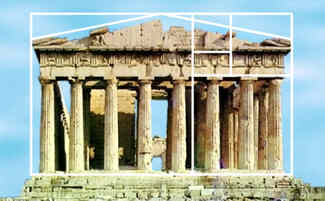
| The Golden Ratio - An Expression of Geometry & Art |
Tying concepts into last week, I immediately noted that R. Buckminster Fuller's concept of de-geniusing children harkened back to the RSA video's study on education and creative thinking (Robinson). To recall, kindergarteners perceived multiple answers to a question, but through the education process began to see the world in binaries and categories. Buckminster's quote set the precedence for this week in once again deconstructing the binaries that we place on subjects like "Math" or "Art".
Moreover, analyzing the intersection of Mathematics and Art/Science this week challenged me to understand the long-standing depth of influence that Mathematical concepts have had in the fields of Art/Science dating back to the ancient eras of Egyptian Pyramids or Greco-Roman Temples (Lecture, Vesna). Though Vesna explained how The Computer, novel to the past few decades, has helped bridge the gap between Art and Math in new ways, lecture also elaborated on how the two fields have been long intertwined for centuries in ways that have not always been as obvious, such as through the Golden Ratio of ancient times which represented both the geometry of a blueprint and the beauty of a temple.
 |
| Origami - A Precise, Calculated Art-Form |
Spotlight Focus ---
An art form that I chose to focus on for it's intersection of Art and Math was the similarly long-standing art of Origami (Origami, Lang). Lang elaborated on the "subset of mathematics" that manifests itself through the laws of Origami. The emphasis on the logical structure and precise measurements, commonly associated with the Math field, unpacks that Art is not solely defined by the stereotypical abstract and loose expression, but sometimes concrete and precise creativity as well.
Mathematics & Creative Expression ---
In a similar vein to Origami expression as logical and structured rather than abstract, I've seen this theme of math-influenced art play out largely in the field of architecture: a study guided by both mathematical precision and geometry as it is guided by the aesthetic and creativity of art.
 |
| Pollock Painting - An Un-Calculated, Math-Free Art Form |
Ultimately, the juxtaposition between Math and Art|Sci is that they do come together and work together, albeit through forms that will follow the guidelines of precise, calculated math-concepts and aesthetic-heavy, expressive facets of art. Math helps us form Arts and Sciences that will be geometric and linear. Though it is hard to bridge Math into the unpredictable and haphazard splatter paint of a Pollock piece (above), Math consistently proves present in any art that is calculated.
Citation
Abbott, Edwin Abbott. Flatland: A Romance of Many Dimensions. New York: n.p., 1963. Print.
"Golden Ratio." Golden Ratio. Math Is Fun, n.d. Web. 12 Apr. 2015.
Henderson, Linda D. "The Fourth Dimension and Non-Euclidean Geometry in Modern Art Linda Dalrymple Henderson." Leonardo 17.3 (1984): 205-10.JStor. Web. 12 Apr. 2015.
Lang, Robert J. Origami Cardinal. Digital image. Lang Origami. Robert J. Lang, n.d. Web. 12 Apr. 2015. <http://www.langorigami.com/image.php?image=/art/birds/cardinal_3d.jpg&width=600&height=450&cropratio=600:450>.
Lang, Robert J. "Origami Mathematics." Origami Mathematics. Robert J. Lang, n.d. Web. 12 Apr. 2015.
Pollock, Jackson. Convergence. Digital image. Jackson Pollock: Biography, Paintings, and Quotes. Jackson-pollock.org, n.d. Web. 12 Apr. 2015. <http://www.jackson-pollock.org/images/paintings/convergence.jpg>.
RSA Animate - Changing Education Paradigms. Prod. Abi Stephenson. Perf. Sir Ken Robinson. RSA Animate - Changing Education Paradigms. Youtube, 19 Oct. 2010. Web. 3 Apr. 2015.
Unknown. Parthenon Golden Ratio. Digital image. Math Is Fun. Math Is Fun, n.d. Web. 12 Apr. 2015. <https://www.mathsisfun.com/numbers/images/parthenon-golden-ratio.jpg>.


